
Fueling the XC/Track and Field Student Athlete

TF/XC athletes NEED ample carbs, protein, and calories to compete at their best. Learn just how much in Wendi's most recent blog post.

Track & Field athletes compete in one or more events that consist of running, throwing, and jumping. Track and field competitors train for strength, speed, power, and endurance and require adequate nutrition and hydration to support the demands of the sport. In order to excel in the season of season nutrition, sleep, recovery, and overall habits are critical.

Track & field/ XC athletes require a high amount of calories, carbohydrates, and sufficient protein.

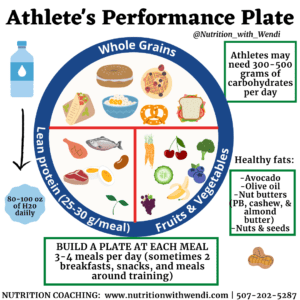
The number of calories, carbs, protein, and fat will depend on the phase of training, along with the intensity, and whether the athlete is in season, pre-season, or in the off-season. The athlete’s performance plate is a simple place to start. Portions will vary based on the athlete’s goals and training phase respectively.

Fueling the XC/Track and Field Student Athlete_Athlete Performance Plate
Fueling the XC/Track and Field Student Athlete_Top Carb Sources for Endurance Atheletes

Carbohydrate requirements in the health and fitness industry are constantly being debated. Randomized control trial studies which are the gold standard for research support the notion endurance athletes require carbohydrates for optimal performance.

Regardless, the carb conundrum continues on leading to significant confusion amongst both young, college, and even masters athletes. I can’t tell you how many countless conversations I have had with fellow dietitians, practitioners, and sports scientists about this carbohydrate debacle. 

Several keto and carnivore physicians are making the water even more muddled with their banter on carb needs for competitive athletes and even young athletes without respect to context. I have written many blogs about fueling young athletes based on the position stand papers of both the American College of Sports Medicine (ACSM) and the International Society of Sports Nutrition (ISSN). Read here

Over the years I have delivered presentations to high schools, clubs, and collegiate programs on how to properly eat and fuel for endurance and power.

Below is a table outlining the recommendations using common body weight for an athlete that we have received great feedback on Specifically from one of the NWW  partners, DOANE University Track and Field.

Why focus on nutrient quality?

👟Protein for muscle maintenance, growth & repair

👟Hydration and minerals for muscle contraction & cardiac function

👟Carbs + calories for power, speed, strength & endurance

Fueling the XC/Track and Field Student Athlete_Doane Atheltics

The TheAcademy of Nutrition and Dietetics (AND), Dietitians of Canada (DC), and the American College of Sports Medicine (ACSM) published a joint position stand paper that recommends that moderate exercise (1 h/day (h/day) recommends 5–7 g per kilogram of body weight per day (g/kg/day) of CHO.

  • Whereas moderate to high-intensity exercise (1–3 h/day) requires 6–10 g/kg/day. 
  • Ultra-endurance athletes with extreme levels of commitment to daily activity (4–5 h of moderate to high-intensity exercise every day) may need up to 8–12 g/kg/day (2). 
  • The International Society of Sports Nutrition (ISSN) recommends in order to maximize glycogen stores athletes should consume an 8–12 g/kg/day high CHO diet (1).
Fueling the XC/Track and Field Student Athlete_2500 Kcal Athlete Meal

Another common example of a 165 lb.👟 that is best to spread meals and snacks throughout the day but focus on eating within targets listed below:

👉375-525g carbs

👉120-150g protein

👉60-80g fat

Total kcal range: 2,500-3,500 kcal

  • Practical application:

    That being said you can take a look at a simple fueling example for XC/TF athletes along with some recommendations on snacks. 

Fueling the XC/Track and Field Student Athlete_Nutrition for XC/Track Athlete

In good health, faith, and fitness

-Wendi A. Irlbeck, MS, RDN, LD, CISSN

The Nutrition with Wendi team utilizes evidence-based science to tailor nutrition programs for athletes to optimize performance, minimize health risks, and enhance recovery from training while focusing on injury prevention. We partner with parents, athletes, health professionals, and individuals and offer elite nutrition and health guidance for optimal athletic performance, injury, and disease reduction.  We provide virtual services including telehealth but are based in Nashville, TN. Follow us on TwitterFacebook, and Instagram for more nutrition information. Services booking here

Resources
1. Thomas D.T., Erdman K.A., Burke L.M. Position of the Academy of Nutrition and Dietetics, Dietitians of Canada, and the American College of Sports Medicine: Nutrition and Athletic Performance. J. Acad. Nutr. Diet. 2016;116:501–528. doi: 10.1016/j.jand.2015.12.006.
2 Vitale, K., & Getzin, A. (2019). Nutrition and Supplement Update for the Endurance Athlete: Review and Recommendations. Nutrients, 11(6), 1289. https://doi.org/10.3390/nu11061289
3.Kloby Nielsen, L. L., Tandrup Lambert, M. N., & Jeppesen, P. B. (2020). The Effect of Ingesting Carbohydrate and Proteins on Athletic Performance: A Systematic Review and Meta-Analysis of Randomized Controlled Trials. Nutrients, 12(5), 1483. https://doi.org/10.3390/nu12051483
Share these nutrition tips with your network

Is Your Athlete Fueling Enough to Perform & Stay Healthy?

Most high school and college athletes don’t struggle because they aren’t training hard enough.

They struggle because they are:

👉Under-fueling without realizing it
👉 Eating “healthy” but not enough for sport
👉Training hard while under-recovering

Over time, this leads to:
– Low energy
– Poor recovery
– Increased injury risk

I created a free Athlete Fueling Checklist to help parents and athletes identify common fueling mistakes and understand what to fix next.