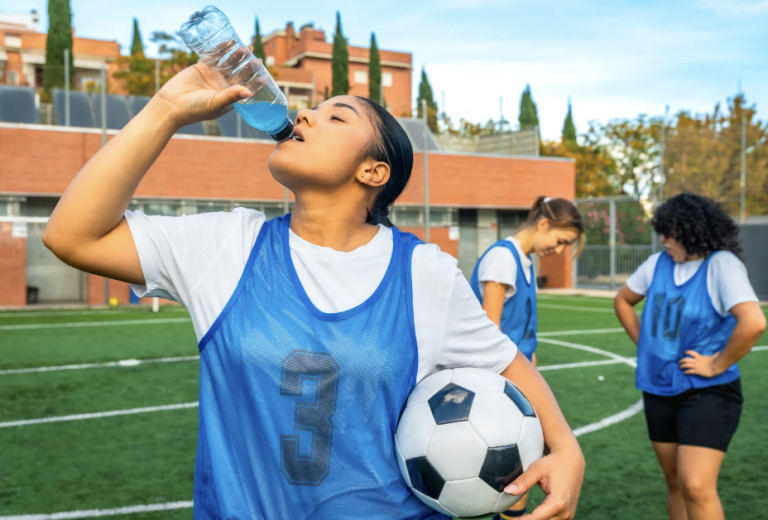
Water is the most underrated performance enhancer in sport. It’s free, it’s available at every practice, and most athletes still walk around dehydrated.
That matters more than most parents and coaches realize. A fluid loss of just 1–2% of body weight — about 2 to 3 pounds for a 150-pound athlete — is enough to slow reaction time, reduce power output, raise perceived effort, and impair the body’s ability to cool itself. For an athlete training in summer heat, that same deficit is the front edge of heat illness.
Here’s what your athlete actually needs, how to know if they’re getting it, and how hydration ties into the two problems I get asked about most: muscle cramping and heat stroke
How Much Water Should a Student Athlete Drink Per Day?
Most general guidance lands at 6–8 glasses per day, and according to the USDA, over half of U.S. adults don’t even hit that. But that number was never built for athletes.
Athletes need more, because they lose more. Body size, training intensity, sweat rate, altitude, and heat all push the number up.
Practical daily targets:
Non-athlete adults: 80–100 oz per day
Student athletes: 90–120 oz per day, plus replacement of minerals lost in sweat
Outdoor training in heat: More than 120 oz, guided by sweat rate
Water supports blood circulation, joint and tissue lubrication, digestion, metabolism, and muscle contraction. When an athlete is short on fluid, blood volume drops, the heart works harder to move oxygen to working muscle, and performance falls off before the athlete ever feels thirsty.
How to Calculate Your Athlete’s Sweat Rate
This is the single most useful thing you can do, and it takes one practice.
Have your athlete weigh in before practice, with minimal clothing, after using the restroom.
Track how much fluid they drink during practice, in ounces.
Weigh in again after practice, toweled off and in dry clothes.
Subtract post-practice weight from pre-practice weight. Every 1 pound lost = roughly 16 oz of sweat.
Add back the fluid they drank during practice to get total sweat loss.
Then replace it: 16–24 oz of fluid for every pound lost.
Run this on a hot day and a mild day. Athletes are often shocked by the difference. Some kids lose 2 pounds in a session; some lose 6. A blanket “drink more water” recommendation doesn’t serve either of them.
Signs of Dehydration in Young Athletes
Urine color is the fastest field check available, and it’s free.
Pale yellow, like lemonade → well hydrated
Dark yellow, like apple juice → drink up
Amber or brown → significantly dehydrated, address immediately
Other warning signs to watch for:
Headache
Fatigue that doesn’t match the workload
Dizziness on standing
Muscle cramping
- Irritability or trouble concentrating
- Nausea
- Elevated heart rate at a normal effort level
- One more pattern worth naming: intense training plus under-fueling raises the risk of injury, low mood, poor performance, and muscle loss. Dehydration rarely shows up alone. When an athlete isn’t drinking enough, they’re usually not eating enough either.
Does Dehydration Cause Muscle Cramps?
This is where I’d push back on the conventional advice a little, because the science has moved.
For years, exercise-associated muscle cramps were blamed entirely on dehydration and electrolyte loss. The current research points to a more complicated picture: most cramping appears to be driven by neuromuscular fatigue — muscles worked past what they’re conditioned for, at intensities or durations they aren’t prepared for, cause a breakdown in the reflexes that control contraction and relaxation. READ 3 WAYS TO PREVENT MUSCLE CRAMPING
That said, fluid and sodium still matter, especially for a specific athlete:
The “salty sweater.” If your athlete finishes practice with white salt crust on their skin, hat, or jersey, they’re losing meaningful sodium. These athletes cramp more, and they need sodium replacement, not just water.
A realistic cramping plan:
- Train the way you compete. Conditioning that matches game demands is the best cramp prevention there is.
- Replace sodium, not just fluid. Add an electrolyte drink, a sports drink, salted foods, or a pinch of salt in a water bottle for salty sweaters.
- Don’t over-drink plain water. Large volumes of water without sodium can dilute blood sodium, which is its own risk.
- Fuel adequately. Muscle glycogen depletion contributes to fatigue-driven cramping.
- Check sleep. Under-recovered athletes fatigue earlier and cramp earlier.
If an athlete cramps chronically despite good hydration, the answer usually isn’t more water. It’s conditioning, fueling, or sodium.
Preventing Heat Stroke in Athletes
Exertional heat stroke is 100% preventable, and it can be fatal when it’s missed. During summer camps, two-a-days, and early-season practices, preparation isn’t optional.
1. Acclimatize slowly
Give athletes 7–14 days to adapt to the heat. Start with lighter, shorter sessions, limit equipment early on, and build volume and intensity gradually. Most catastrophic heat illness happens in the first week of preseason, on athletes who went from an air-conditioned summer straight into full pads.
2. Hydrate on a schedule
- Before: 16–20 oz, 2–3 hours prior to activity
- During: 7–10 oz every 10–20 minutes
- After: 16–24 oz per pound of body weight lost, with electrolytes
3. Schedule practices around the heat
Train early morning or evening. Avoid peak heat. Monitor the heat index or WBGT (wet bulb globe temperature) and have written thresholds for modifying or canceling practice — decided in advance, not in the moment.
4. Dress to release heat
Light-colored, loose, moisture-wicking clothing. Remove helmets and pads during breaks. Equipment traps heat and blocks evaporative cooling, which is the body’s primary defense.
5. Know the warning signs
Headache, nausea, confusion, disorientation, irritability, cramping, flushed skin, stumbling, or an athlete who “isn’t acting right.” Central nervous system changes are the red flag. Confusion is an emergency, not a water break.
6. Build cooling into the practice plan
Shade, fans, ice towels, and mandatory rest breaks roughly every 20 minutes in high heat. A cold water immersion tub on site is not overkill — it’s standard of care, and it saves lives.
7. Have an emergency action plan
Every team needs a written heat illness plan that everyone has practiced.
Cool first, transport second. For suspected exertional heat stroke, cold water immersion begun immediately gives the best survival odds — waiting for an ambulance to cool the athlete costs critical minutes. Core temperature above 104°F (40°C) with central nervous system dysfunction is a medical emergency. Note that rectal temperature is the only valid field measurement; oral, ear, and forehead readings are unreliable in an exercising athlete and have contributed to missed diagnoses.
7 Hydration Tips You Can Apply Today
1. Drink water before you get out of bed
Put a full bottle on the nightstand the night before. Zero barriers, zero decisions. Aim for 10–16 oz on waking — athletes wake up already down a pound or two of fluid from overnight losses.
2. Set phone alarms to hydrate
Sixteen ounces every few hours, working toward 100–120 oz. Or simplify it into two checkpoints: 50 oz by 1 p.m., another 50 oz by 7 p.m. Athletes who hit checkpoints stop trying to catch up at 9 p.m. Grab my full hydration schedule HERE.
3. Carry a bottle you can count
A 32 oz bottle makes the math obvious: three refills gets you to 96 oz. A bottle that isn’t with you doesn’t get drunk.
4. Eat your hydration
Fruits and vegetables deliver fluid and minerals. Watermelon, grapes, berries, oranges, cucumber, celery, carrots, cherries, and tomatoes all count toward daily intake. Infusing water with berries, lemon, or lime makes it more appealing to picky teenagers, which matters more than any of us like to admit.
5. Use electrolytes when the situation calls for it
Sodium, potassium, magnesium, and calcium are lost in sweat and need replacing after long or hot sessions. Dairy is genuinely underrated here — milk, Greek yogurt, and cheese supply fluid, minerals, and protein together. Chocolate milk, tart cherry juice, and low-sugar sports drinks all have a place depending on the athlete’s goals and workload.
6. Pack a cooler
Stock it with fruit, vegetables, and extra bottles. Tournaments, meets, and long travel days are where hydration falls apart — usually because nothing was available, not because nobody cared.
7. Milk at meals, water in between
A simple pattern that works. And after training, replace what you lost: 16–24 oz for every pound of body weight lost.
Frequently Asked Questions
How much water should a high school athlete drink per day? Most student athletes need 90–120 oz per day, with more required on hot days or during two-a-days. The most accurate approach is calculating individual sweat rate and replacing 16–24 oz of fluid per pound of body weight lost during training.
What are the signs of dehydration in a young athlete? Dark yellow urine, headache, unusual fatigue, dizziness, cramping, nausea, irritability, and an elevated heart rate at normal effort. Thirst is a late indicator — an athlete who feels thirsty is already behind.
Do student athletes need sports drinks, or is water enough? Water covers most training under 60 minutes in mild conditions. Sessions longer than an hour, hot-weather training, two-a-days, and athletes who are heavy or salty sweaters benefit from added sodium and carbohydrate from a sports drink or electrolyte product.
Will drinking more water stop muscle cramps? Sometimes, but not always. Current research points to neuromuscular fatigue as the primary driver of exercise-associated cramping. Sodium replacement helps athletes who lose a lot of salt in sweat, but conditioning, adequate fueling, and recovery matter just as much.
How long does heat acclimatization take? Plan on 7–14 days of progressive exposure, starting with shorter, lighter sessions and limited equipment. Most serious heat illness occurs during the first week of preseason.
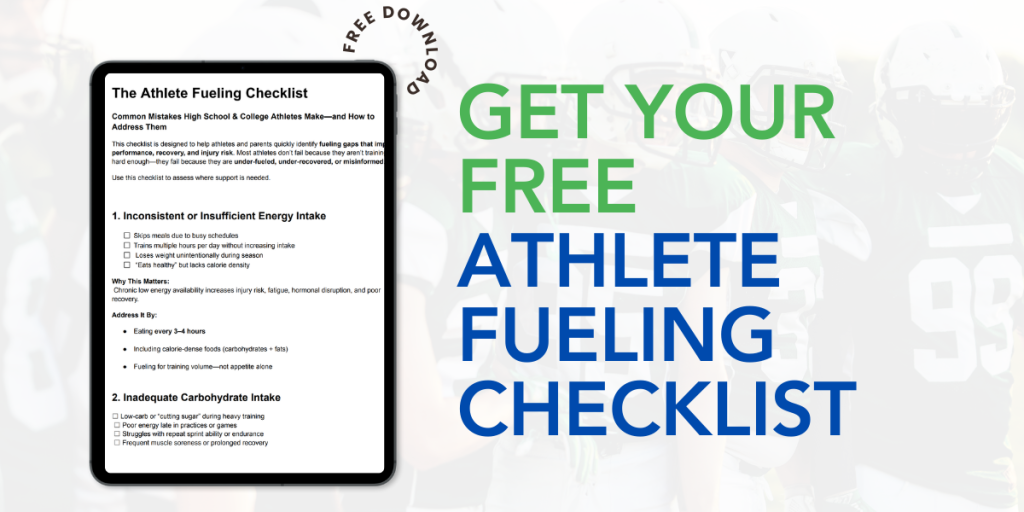
Is Your Athlete Fueling Enough to Perform and Stay Healthy?
Most high school and college athletes don’t struggle because they aren’t training hard enough. They struggle because they’re under-fueling without realizing it, eating “healthy” but not eating enough for their sport, and training hard while under-recovering. Over time that shows up as low energy, poor recovery, and increased injury risk.
If you’re an athlete, parent, or coach trying to figure this out on your own—you don’t have to.
Inside my Athlete Membership, I give you the exact tools we use with high school and collegiate athletes:
✔️ Sport-specific fueling plans
✔️ Meal and snack guides
✔️ Grocery lists + meal prep strategies
✔️ Performance nutrition education
✔️ Proven systems used with real athletes
👉 Join here:
https://www.nutritionwithwendi.com/membership/
 In good health, faith, and fitness
Wendi Irlbeck, MS, RDN, LD, CISSN
Wendi Irlbeck is a registered dietitian nutritionist and performance coach who specializes in evidence-based sports nutrition for high school and collegiate athletes. She designs strategic fueling systems that support performance optimization, recovery, and injury risk reduction, while minimizing health risks associated with under-fueling, overtraining, and misinformation. Wendi partners with parents, coaches, athletic trainers, athletic directors, educators, and sports performance staff to deliver practical nutrition education and sustainable performance-driven lifestyle plans. Her team provides virtual services nationwide, including sports nutrition presentations, 1:1 and group coaching, and structured athlete development programs for families and active adults.
Work With Wendi
→ Fueling the female athlete
How many calories, carbs, protein and fat is required to fuel the 8-18 YO female athlete. Learn more… HERE.
→ Elite 12-Week Elite Athlete Membership
I✔️ Sport-specific fueling plans
✔️ Meal and snack guides
✔️ Proven systems used with real athletes
👉 Join here:
https://www.nutritionwithwendi.com/membership/
→ Download the Health & Performance Playbook
Foundational nutrition principles every athlete and family should know.
Get the playbook
→ Questions and other inquiries for Wendi + The Wendi Irlbeck Show
Foundational nutrition principles every athlete and family should know.
Get in touch
 Under-fueling without realizing it