
If you ask many parents how to help youth athlete become a better athlete, they’ll often assume the answer is simple: play one sport year-round. However, the research tells a different story.
The strongest, healthiest, and most resilient athletes often have two things in common:
- They participate in multiple sports during childhood and adolescence.
- They follow a properly supervised strength training program.
As a registered dietitian and certified sports nutritionist, I work with athletes every day who want to improve performance while staying healthy enough to compete. Long-term athletic development isn’t about doing more—it’s about training smarter and consuming the proper meals and snacks at the right time!
Why Playing Multiple Sports Matters
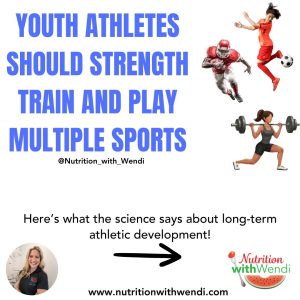 Youth sports have become increasingly specialized, yet injury rates continue to rise.
Research from the University of Wisconsin School of Medicine and Public Health evaluated more than 1,500 high school athletes and found athletes who specialized in a single sport were twice as likely to report lower-extremity injuries compared with athletes who participated in multiple sports. Specialized athletes also experienced significantly more lower-body injuries. Teen baseball athletes often under-eat in protein, carbs and calories. Grab the baseball fueling guide HERE.
Additional research published in the Journal of Sports Sciences found boys ages 10–12 who participated in multiple sports demonstrated better standing broad jump performance and superior gross motor coordination than athletes specializing in just one sport.
Playing multiple sports helps young athletes develop:
- Better coordination
- Improved balance
- Greater athleticism
- Enhanced movement skills
- Reduced overuse injuries
The American Medical Society for Sports Medicine also reported that approximately 88% of collegiate athletes played more than one sport growing up. Grab the football student athlete fueling guide HERE. Many legendary athletes were multisport competitors, including Bo Jackson, Danny Ainge, Tom Glavine, Babe Didrikson Zaharias, and Bob Gibson.
Why Every Youth Athlete Should Strength Train
Strength training is one of the most researched methods for improving athletic performance and reducing injury risk. When supervised by qualified professionals using age-appropriate exercises, resistance training has been shown to:
- Increase muscular strength by 30–50% through neuromuscular adaptations
- Reduce sports-related injuries by approximately 30–50%
- Improve bone mineral density during critical growth years
- Increase speed, power, agility, and athletic performance
- Enhance movement quality and coordination
- Improve lean muscle mass and metabolic health
- Increase confidence and psychological well-being
Perhaps most importantly, research consistently shows there is no evidence that properly supervised resistance training stunts growth or damages growth plates. Youth athletes should be avoiding pre-workouts and energy drinks that are dangerous for their health!
Get a copy of my athlete meal and snack guide optimal health and performance!
Female Athletes and ACL Injury Prevention
 Female soccer players face a substantially greater risk of ACL injuries than males, with studies reporting they are two to six times more likely to experience these devastating knee injuries.
Several factors contribute to this increased risk, including:
- Anatomical differences
- Hormonal fluctuations
- Low iron and ferritin
- Poor nutritional intake
- Neuromuscular control
- Landing mechanics
- Hip and knee stability
- Inadequate sleep *How much sleep do athletes need?
The good news? Neuromuscular training programs have been shown to reduce ACL injury rates by up to 50%.
Exercises that should become part of every female athlete’s strength program include:
- Single-leg deadlifts
- BOSU balance drills
- Lateral band walks
- Box jumps with controlled landings
- Walking lunges
- Single-leg squats
- Agility ladder drills
- Plyometric training emphasizing proper landing mechanics
These exercises strengthen the hips, glutes, hamstrings, and core while improving balance, coordination, and knee stability.
Don’t Forget Proper Nutrition
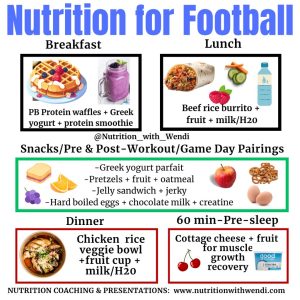 Strength training alone isn’t enough. Young athletes need adequate calories, carbohydrates, protein, healthy fats, hydration, vitamins, and minerals to recover, build muscle, and support normal growth and development.
Under-fueling can increase fatigue, delay recovery, reduce performance, and elevate injury risk. Click here to learn more about what to eat before and after training and games! Smart supplementation with creatine monohydrate and vitamin D3 can also help reduce the risk of injury and illness. Avoid over-consuming ultra-processed foods.
That’s why nutrition should be developed alongside strength and conditioning—not treated as an afterthought. Nutrition tips for recovering from an injury or post-surgery. Check out my tasty high-protein weight gain smoothies!
Help Your Athlete Build a Strong Foundation
Whether your athlete plays football, XC, baseball, softball, basketball, soccer, tennis, volleyball, track and field, or another sport, building athleticism early pays dividends for years to come. Most athletes skip breakfast and often do not consume a balanced three to four daily mails required to meet fueling demands.
At Nutrition With Wendi, I’ve created resources designed to help athletes fuel properly and train smarter, including:
- 12-Week Fueling the Elite Student-Athlete Program
- Sport-specific Fueling Guides
- Evidence-based education designed for long-term athletic development
The goal isn’t simply creating a better athlete for next season. It’s developing healthier, stronger, more confident athletes who can compete for years to come.
Ready to help your athlete reach the next level?
Want more tailored support for food allergies? Grab the complete food allergy guide for athletes HERE. If you’re a parent or coach looking for meal and snack plans, grocery lists, and sport specific fueling strategies grab the Health and Performance Playbook. It’s designed to take the guesswork out of fueling student-athletes for peak performance.Nutrition is your secret weapon. If you want to be elite you must eat, train, fuel and prioritize sleep like an elite athlete!
In good health, faith, and fitness
Wendi Irlbeck, MS, RDN, LD, CISSN
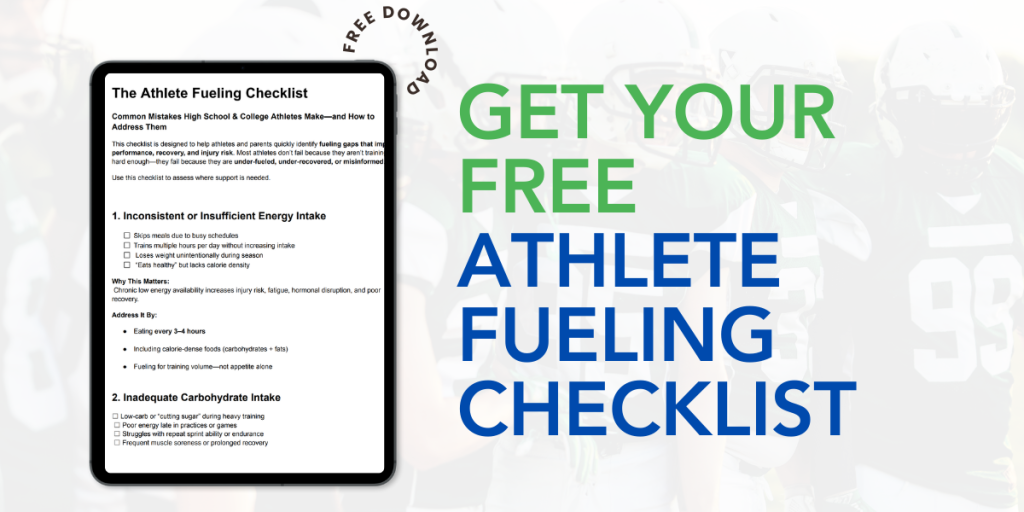
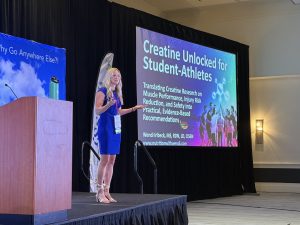 Wendi is a registered dietitian nutritionist and performance coach who specializes in evidence-based sports nutrition for high school and collegiate athletes. She designs strategic fueling systems that support performance optimization, recovery, and injury risk reduction, while minimizing health risks associated with under-fueling, overtraining, and misinformation. Wendi partners with parents, coaches, athletic trainers, athletic directors, educators, and sports performance staff to deliver practical nutrition education and sustainable performance-driven lifestyle plans. Her team provides virtual services nationwide, including sports nutrition presentations, 1:1 and group coaching, and structured athlete development programs for families and active adults.
→ Book a 1:1 Nutrition Consultation
Strategic guidance for athletes, parents, and active adults seeking clarity and results.
Schedule your consult here
→ Fueling the female athlete
How many calories, carbs, protein and fat is required to fuel the 8-18 YO female athlete. Learn more… HERE.
→ Elite 12-Week Elite Athlete Membership
I✔️ Sport-specific fueling plans
✔️ Meal and snack guides
✔️ Proven systems used with real athletes
👉 Join here:
https://www.nutritionwithwendi.com/membership/
→ Download the Health & Performance Playbook
Foundational nutrition principles every athlete and family should know.
Get the playbook
→ Questions and other inquiries for Wendi + The Wendi Irlbeck Show
Foundational nutrition principles every athlete and family should know.
Get in touch
 Under-fueling without realizing it