
 Ultra-processed foods are everywhere—found in locker rooms, supplement stores, concession stands, grocery aisles, and gas stations, and often marketed as “healthy” or “sports fuel.” While whole and minimally processed foods should form the foundation of an athlete’s diet, fueling for performance requires more than just “clean eating.” Athletes have significantly higher energy, carbohydrate, and protein needs than non-athletes to support training demands, recovery, and overall performance. Understanding how to strategically incorporate both whole foods and convenient options is key to meeting these increased nutritional demands without compromising health. Supplements are technically ultra-processed; they can be healthy and a useful tool to reduce the risk of illness, injury and maintain lean mass during training. Especially creatine monohydrate.
 Ultra-processed foods are everywhere—found in locker rooms, supplement stores, concession stands, grocery aisles, and gas stations, and often marketed as “healthy” or “sports fuel.” While whole and minimally processed foods should form the foundation of an athlete’s diet, fueling for performance requires more than just “clean eating.” Athletes have significantly higher energy, carbohydrate, and protein needs than non-athletes to support training demands, recovery, and overall performance. Understanding how to strategically incorporate both whole foods and convenient options is key to meeting these increased nutritional demands without compromising health.
 Understanding ultra-processed foods goes far beyond general nutrition. The foods we eat as athletes, adults and families directly influence energy levels, recovery, body composition, injury risk, and long-term health. More than 58% of total calorie intake in the average U.S. diet comes from ultra-processed foods. The NOVA food classification system offers the clearest way to understand them by focusing on the degree of industrial processing rather than just calories or macros. Before you read on, here’s a quick athlete report card. How did you score with healthy habits?
The NOVA system divides foods into four groups:

- Group 1: Unprocessed or minimally processed foods. Foods closest to their natural state: fruits, vegetables, meat, eggs, milk, rice, beans, potatoes. They may be cleaned, cut, frozen, or pasteurized, but their structure and nutrients remain largely intact.
- Group 2: Processed culinary ingredients. Oils, butter, sugar, and salt- ingredients extracted from whole foods and used in home cooking.
- Group 3: Processed foods — Made by adding Group 2 ingredients to Group 1 foods. Examples: cheese, canned vegetables, fresh bread.
- Group 4: Ultra-processed foods — Industrial formulations with additives, preservatives, flavor enhancers, emulsifiers, and ingredients you wouldn’t typically find in a home kitchen. Common examples: packaged snacks, soda, fast food, many protein bars, flavored instant oats, and some ready-to-drink shakes and energy drinks. Episode 10 of the Wendi Irlbeck show breaks down the dangers of energy drinks.
Key principle: The further a food moves away from its original form through industrial processing, the greater the potential differences in digestion speed, satiety, blood sugar response, and overall impact on performance and health.
Real-World Examples: Processing Changes the Outcome
Take a simple potato: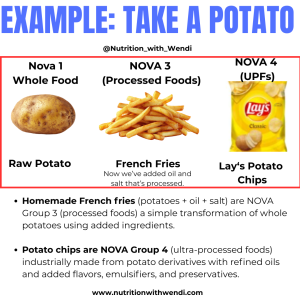
- Baked potato → Group 1 (minimally processed) — Provides steady energy thanks to intact fiber and structure.
- French fries → Group 3 (processed) — Oil and salt added.
- Potato chips → Group 4 (ultra-processed) — Engineered for maximum taste and shelf life, often leading to quicker digestion and lower satiety.
What about oats for athletes?
- Steel-cut or rolled oats (Group 1) preserve fiber for slower digestion, stable blood sugar, and sustained energy — ideal for early morning football practices or baseball warm-ups.
- Instant flavored oatmeal packets (often Group 4) add sugars, flavorings, and stabilizers, shifting toward energy spikes and potential crashes.
What about fruit?

- Fruit: Whole apples, berries, bananas, or cherries (Group 1) deliver fiber, water, and micronutrients that slow glucose absorption and support gut health and satiety.
- 100% fruit bar: NOVA Group 3 (processed food): made from mashed, dried fruit so it’s a concentrated form of whole fruit. It still provides fiber, vitamins, and antioxidants and can be a healthy option it’s classified as processed due to transformation, not because it’s unhealthy.
- Fruit snacks, gummies, and fruit drinks (Group 4) typically use concentrates, added sugars, and remove much of the fiber.
Important nuance for parents and athletes: Unsweetened applesauce (Group 3) is cooked and puréed, breaking down some fiber for faster digestion while retaining nutrients. It sits between whole fruit and ultra-processed options. Many athletes successfully use 100% fruit bars or unsweetened applesauce pouches for convenient pre- or post-training carbs.
Protein Sources: Quality vs. Convenience
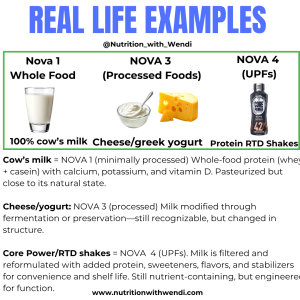
Plain cow’s milk (Group 1) is a high-quality, complete protein source naturally containing both whey and casein.
- It supports muscle repair and recovery while delivering calcium, potassium, and B vitamins nutrients critical for bone health, hydration, and performance in contact sports like football or power movements in baseball.
- Ready-to-drink protein shakes and many powders undergo ultra-filtration, added isolates, sweeteners, stabilizers, and emulsifiers, placing them in Group 4. They are convenient tools, not whole foods. But still can contain nutrients.
Here are better upgrades for student athletes to fuel health and performance on my Nutrition with Wendi Instagram page.
More on protein powders and athlete recovery:
Protein powders can still provide high-quality complete protein and are valuable when whole-food options aren’t practical — especially for football players with high protein needs or baseball players on tight schedules.
Chocolate milk is more processed than plain milk due to added sugar and flavoring, but it remains a practical post-workout option. It supplies carbs for glycogen replenishment, protein for muscle repair, and electrolytes particularly useful after post-swimming, football practices and games or between baseball and softball doubleheaders.
Nutrition Impacts Health and Athletic Performance
 Nutrition Impacts Health and Athletic Performance
A performance nutrition plan built primarily on Groups 1–3 supports:
- Stable energy and better blood sugar control
- Improved recovery and reduced soreness
- Better body composition and lower inflammation risk
- Stronger satiety and nutrient density
High intake of ultra-processed foods is associated with energy fluctuations, poorer satiety, lower overall nutrient density, and potential long-term health concerns when they displace whole foods. Active adults should be focused on eating mostly whole foods to maintain a healthy body weight as well, especially > 40 years old. Lead by example parents and coaches! Wendi’s fit > 40 program for help!
For student athletes, the goal isn’t perfection or demonizing convenient items. All foods fit! It is important to have a healthy relationship with food with intentional fueling: prioritize nutrient-dense, minimally processed foods as the foundation, and use ultra-processed or highly convenient options strategically around training or games when speed of digestion, portability, or timing matters most. Especially for track and field athletes concerned with gut health.
Foods aren’t “good” or “bad.” Evaluate them by nutrient density + context — how they fit into your overall pattern to support performance demands. Practical Fueling Strategies for Baseball and Football Players
Pre-practice or pre-game fueling (tailored to variable schedules:
- 3–4 hours before: Turkey or chicken bagel sandwich + fruit; lean ground turkey rice bowl + veggies; whole grain pasta with grilled chicken + fruit.
- 1–2 hours before: Unsweetened applesauce + pretzels; Greek yogurt with berries; banana + small handful of pretzels or rice cakes with honey.
- 30 minutes or less: 100% fruit bar or dried fruit; rice cake + honey; applesauce pouch. Focus on quick-digesting carbs to top off glycogen stores without GI distress. Especially for early morning training.
Daily fueling needs (adapt for multisport athlete’s strength and endurance demands or explosive power):
- Carbs: Prioritize whole grains, potatoes, rice, oats, fruit, beans, and vegetables to fuel high-intensity efforts and recovery.
- Protein: 1.4–2.0 g/kg body weight daily from eggs, dairy, chicken, beef, turkey, tofu, beans, nuts, and seeds. Aim for 25–40g per meal and 10–15g per snack.
- Fats: Include nut butters, avocado, olive oil, and seeds to support hormone health and sustained energy.
 Between innings or during long practices/games (baseball doubleheaders or soccer) athletes playing multiple sports:
- Low-fiber, easy-to-digest carbs: 100% fruit bars, applesauce, pretzels, banana + honey on a rice cake, or sports drinks
- For hydration concerns (dizziness, heat-related episodes common in hot weather or dehydration): Prioritize sodium (2,500–4,000+ mg/day) and hydration (½–1 oz fluid per pound of body weight daily, more in heat).
- Use electrolyte mixes like LMNT, Liquid I.V., Drip Drop or Skratch Labs, and salt meals liberally.
Post-training or post-game recovery (within 30–60 minutes):
- Greek yogurt bowl with fruit and granola
- Turkey or tuna sandwich + fruit
- Chicken + rice bowl with veggies
- Add antioxidant-rich foods (blueberries, spinach, oranges) to help reduce inflammation
Breakfast for early or heavy training days. Grab a second breakfast for muscle gain and game days!
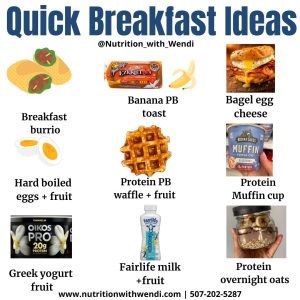
- Greek yogurt + berries + honey
- Oatmeal + PB2 powder + fruit
- Honey + bagel + Greek yogurt
- Simple protein fruit smoothie
- Egg bagel cheese sandwich with turkey bacon
- Avocado egg turkey sandwich + fruit
- Hard boiled eggs + fruit
- Protein waffle + fruit
- Breakfast burrito + fruit + milk
- String cheese + apple slices
Consistency Wins for Student Athlete Health and Performance
Success and optimal health aren’t built on one perfect meal—they’re built on daily consistency. That means prioritizing balanced meals (including breakfast) centered on whole, minimally processed foods, along with smart snacks and proper hydration. A practical, sustainable target is to aim for whole and minimally processed foods about 75–80% of the time across meals and snacks. When athletes fuel with intention, they’re able to train harder, recover more efficiently, reduce injury risk, and perform at a higher level in the field, in the weight room, and in the classroom.
Want more tailored support for food allergies? Grab the complete food allergy guide for athletes HERE. If you’re a parent or coach looking for meal and snack plans, grocery lists, and sport specific fueling strategies grab the Health and Performance Playbook. It’s designed to take the guesswork out of fueling student-athletes for peak performance.Nutrition is your secret weapon. If you want to be elite you must eat, train, fuel and prioritize sleep like an elite athlete!
In good health, faith, and fitness
 Wendi Irlbeck, MS, RDN, LD, CISSN
Wendi Irlbeck is a registered dietitian nutritionist and performance coach who specializes in evidence-based sports nutrition for high school and collegiate athletes. She designs strategic fueling systems that support performance optimization, recovery, and injury risk reduction, while minimizing health risks associated with under-fueling, overtraining, and misinformation. Wendi partners with parents, coaches, athletic trainers, athletic directors, educators, and sports performance staff to deliver practical nutrition education and sustainable performance-driven lifestyle plans. Her team provides virtual services nationwide, including sports nutrition presentations, 1:1 and group coaching, and structured athlete development programs for families and active adults.
Work With Wendi
→ Book a 1:1 Nutrition Consultation
Strategic guidance for athletes, parents, and active adults seeking clarity and results.
Schedule your consult here
→ Team Talks, Workshops, Clinics & Partnerships/Speaking
Professional sports nutrition education for teams, clubs, schools, and organizations.
Inquire about speaking and partnerships HERE.
→ Elite 12-Week Elite Athlete Membership
Inside my Athlete Membership, I give you the exact tools we use with high school and collegiate athletes:
✔️ Sport-specific fueling plans
✔️ Meal and snack guides
✔️ Grocery lists + meal prep strategies
✔️ Performance nutrition education
✔️ Proven systems used with real athletes
👉 Join here:
https://www.nutritionwithwendi.com/membership/
→ Download the Health & Performance Playbook
Foundational nutrition principles every athlete and family should know.
Get the playbook
→ Questions and other inquiries for Wendi + The Wendi Irlbeck Show
Foundational nutrition principles every athlete and family should know.
Get in touch

 Under-fueling without realizing it