

 An estimated 1 billion people worldwide, across all ethnicities and age groups, have a vitamin D deficiency according to a review published in the Journal of Pharmacology & Pharmoacotherapeutics . Vitamin D is a steroid hormone that regulates > 1,000 processes in the body, and it has been well known as the “sunshine” vitamin playing an important role in preventing illnesses like, osteoporosis and rickets . Winter days are often dark and sun exposure is limited leading to an increased risk for vitamin D deficiency and infections. Vitamin D is a hormone but is most widely known as a fat-soluble vitamin. Vitamin D promotes calcium absorption in the gut. Vitamin D supports muscle function, cell growth, and immunity. Vitamin D is obtained from supplements, sun exposure, and consuming vitamin D-containing foods like wild salmon, eggs, mushrooms, fortified cereal, and dairy products.
How Much Vitamin D Is Needed?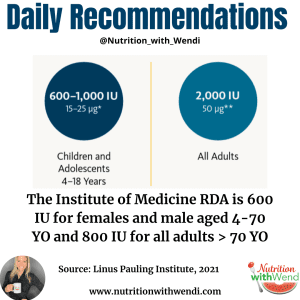
One confusing element of understanding vitamin D guidelines to correct deficiency can be challenging. Currently, there is no consensus definition of vitamin D deficiency according to the U.S. Preventive Services Task Force recently reviewing vitamin D screening. The Institute of Medicine (IOM) guidelines for vitamin D use a blood level of 20 ng/ml o 25-hydroxyvitamin D as a benchmark for deficiency because it is the minimum level that meets the needs for good bone health for at least 97.5% of the population (1). However, the Endocrine Society recommended that people aim for a level of 30 ng/mL or higher . A more comprehensive table of Vitamin D concentrations and health are found here via the National Institute of Health.
Current Recommended Dietary Allowances (RDA) for Vitamin D:
- Birth to 12 months: 400 IU
- Children 1-13 years: 600 IU
- Teens 14-18 years: 600 IU
- Adults 19-70 years: 600 IU
- Adults 71 years and older: 800 IU
- Pregnant and breastfeeding women: 600 IU
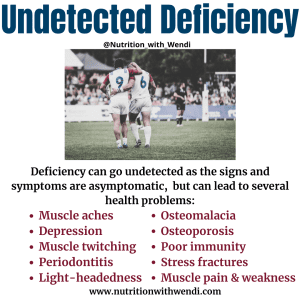
Vitamin D Deficiency Signs and Symptoms that Can Lead to Severe Health Complications:
- Osteomalacia
- Osteoporosis
- Risk of stress fractures
- Muscle aches and weakness
- Muscle twitching
- Periodontitis
- Light-headedness
 In the Body, Vitamin D is Linked with:
- Immune function
- Blood pressure regulation
- Muscle strength and mass
- Absorption of calcium
- Healthy weight management
- Overall bone and teeth health
Vitamin D and Athletes
Numerous studies reviewed in the Journal of the International Society of Sports Nutrition has assessed the possibility for vitamin D’s impact on performance and recovery. In fact a study published in the Journal of Strength and Conditioning Research examining soccer players who supplemented with 5,000 IU of vitamin D per day for a total of eight weeks had interesting results. Those that supplemented jumped higher and were linked to faster sprints.
 A vitamin D deficiency in athletes increases the risk for stress fractures, anemia and a weaker immune system which and blunt athletic performance. A 2008 study examining Vitamin D status in a group of distance runners found that forty percent of the runners, who trained indoors in sunny Baton Rouge, Louisiana had insufficient vitamin D. deficiency is common among athletes and enough levels are needed to maintain bone health and aid in injury repair. A review carried out in 2015 identified about 56% of athletes had inadequate levels of vitamin D. Another study evaluating vitamin D levels in athletes participating at the NFL combine found that players with a history of lower extremity muscle strain and core muscle injury had a greater prevalence of inadequate vitamin. Furthermore, another study assessed the association of vitamin levels with race and found a higher rate of vitamin D deficiency among black football players than white football players.
 As stated above musculoskeletal pain and weakness are often unrecognized symptoms of vitamin D deficiency. A study conducted in Minnesota identified 93% of individuals with persistent non-specific musculoskeletal pain had 25(OH)D concentration <20 ng mL and 28% had a concentration <8 ng mL. Animal studies have also reported that vitamin D deficiency leads to the atrophy of fast-twitch muscle fibers, which are critical in power movements like sprints. Fast-twitch fibers also fatigue faster which can explain the physiological why vitamin D can influence based on its function.
As you have learned, vitamin D deficiency is overlooked and should be a focus of concern for any professionals working with athletes. The strong association in muscle fatigue and low vitamin D levels in elite and collegiate athletes may lead to long-term injuries with life and career-altering effects. An article published in the American College of Sports Medicine provides charts and illustrations representing the vitamin D status in athletes living in various geographic locations.
To Supplement or Not Supplement?
Upon reading this article you can see how challenging it is to achieve daily vitamin D needs from foods and limited sun exposure. Provided the critical role vitamin D plays in our mood, digestion, cognition, recovery, athletic performance, and overall health it would be wise to supplement with 1,000 to 2,000 IU of vitamin D3 per day during the winter solstice months and likely even more if you fall into any of the high-risk categories for vitamin D deficiency. Justifying a greater need for vitamin D for athletes who train often and participate in multiple sports.
- 2 whole eggs (roughly 11.5 g of fat depending upon egg size)
- (Yes whole eggs including the yolk that contains all of the nutrients). You are also getting a great source of highly bioavailable protein when eating eggs because of their leucine content as well. Great for muscle protein synthesis!
- If you can eat breakfast doing a veggie avocado omelet and take your D3 that would be best! But not every athlete is able to take their D3 at home if they get it from the weight room at school. (D1 athletes often receive from RD or SC post-training)
- 2 Tbsp of any type of nut butter (12-18 g of fat)
- The amount of fat will vary based on the type of nut butter
- Choose from cashew, peanut, almond, or sun butter packets (grab and go)
- 1/2 medium avocado (roughly 12 g of fat)
- Avocados are packed with potassium and antioxidants which both support athletic performance and recovery!
- 1.5 oz of chia seeds (13 g of fat)
- Chia seeds are a great anti-inflammatory option that can be added to Greek yogurt, smoothies, and oats and are very convenient to take with a vitamin D3 supplement
- 3/4 cup full-fat Greek yogurt (10 g of fat)
- Yogurt travels well and is easy to eat on the go. Just be mindful of the fat content post-training as we want carbs and protein. Fat takes longer to digest and we want to avoid using the D3 supplement around training because it also has been shown to negatively impact eccentric exercise adaptations. *see my post-workout info on this
- A serving of 16 g of almonds + walnuts (I recommend the snack pack from Emerald)
- Nuts also contain vitamin E, and magnesium a mineral most people and athletes do not get enough of critical for muscle relaxation and contraction.
- Cashews offer 13 g of fat for 1 oz serving (choose your preference)
Many high school, college, or even adult athletes are out the door without a fat source. They pop the pill and guzzle some water. Without pairing your D3 supplement with a fat source the consequences will result in poor absorption and failure to raise vitamin D levels sufficiently. Thus putting the athlete at risk for depression, low bone mineral density, stress fractures, poor cognition, low energy, and poor performance.
 During nutrition coaching sessions and presentations, I have educated athletes and their parents on this tip to pack a fat + D3 tablet with their yogurt or eggs in the morning and it has helped raise their levels to the proper range of 30-.0- 100 ng/mL.
We don’t want to be on the low end of any reference range! That is not what life is about nor do I want any of our athletes to be at the bottom. Life and competition are not about surviving but THRIVING!
 Disclaimer, I am not a physician and I would encourage you to discuss vitamin D testing with your doctor to ensure you’re not reaching toxicity, which can occur with high-dose vitamin D intakes of 60,000 IU per day. Blood levels should be monitored by anyone who chooses to take a higher dose of vitamin D. As always, talk with your doctor and sports medicine staff before taking any vitamin and mineral supplements. Interested in learning more about your vitamin D status? Check out the website of the Vitamin D Society for more information. Other great resources to learn more about vitamin D include the Linus Pauling Institute and the National Institute of Health fact sheet for health professionals.
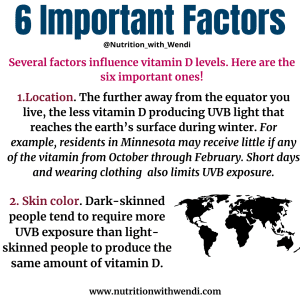
Check out my previous blog highlighting the six risk factors for vitamin D deficiency.
In good health,
Wendi Irlbeck, MS, RDN, LD, CISSN


 Under-fueling without realizing it