



The number that needs no interpretation
Allyson Felix’s lifetime best in the 400 meters is 49.26 seconds. She is one of the most decorated track athletes in history.
In the single year 2017, that time was beaten roughly 15,000 times by men and boys around the world.
That figure comes from Comparing Athletic Performances: The Best Elite Women to Boys and Men, published by Duke Law’s Center for Sports Law and Policy. The same paper found the same pattern for Tori Bowie’s 100-meter best of 10.78.
Read that again. Not fifteen thousand men — fifteen thousand performances, in one year, faster than the lifetime best of a woman who has stood on Olympic podiums. Many of them by athletes who will never make a national team.
That’s not an opinion. That’s a results database. Men have performance advantages over women *Instagram graphics.
Where the gap comes from
Before puberty, there is no meaningful difference. That’s not a concession I’m making reluctantly — it’s what the research shows, and I think you should trust me more for saying it. Handelsman, Hirschberg and Bermon, writing in Endocrine Reviews in 2018, found no sex difference in circulating testosterone or in athletic performance prior to puberty. Boys and girls that age can and do compete together. That’s normal, and nobody should be panicking about it. Then puberty happens.
Male testosterone rises roughly thirtyfold. The testes produce about thirty times more than the body produced before. And the same paper puts the resulting performance advantage at at least 8 to 12 percent driven by differences in muscle mass, strength and hemoglobin.
You can watch that gap open in real time. Tønnessen and colleagues, in PLOS ONE (2015), analyzed the 100 best Norwegian athletes of each sex at every age from 11 to 18, in the 60 meters, the 800, long jump and high jump. Real competition results, not lab tests.
At 11 and 12, the boys and girls were almost dead even. After that, the boys pulled away. Improvement rates were more than 50 percent higher for males in every event analyzed, and the gap grew from under 5 percent to 10 to 18 percent by age 18.
That’s not culture. That’s not coaching. That’s one hormonal event happening to half the population.
 It isn’t one advantage. It’s five.
 It isn’t one advantage. It’s five.
People argue about this like it’s a single variable — as if you could isolate “muscle” and settle it. You can’t. Five separate systems change at once, and they interact. See the full post on Instagram with graphics.
1. The frame
Adult males average roughly 7 to 8 percent taller, with proportionally longer arms and legs. A longer humerus means a longer lever arm — the same muscular force at the shoulder produces more velocity at the hand. Add broader shoulders, a wider ribcage for anchoring the chest and lat musculature, and a narrower pelvis relative to shoulder width, which makes the torso a more efficient structure for transferring force.
What it produces: more force applied over a longer arc. This is why throwing and striking show the widest gaps of anything we measure — pitching velocity, serve speed, punch and kick force, javelin, shot put.
2. The engine
Males carry roughly 35 to 40 percent more total lean mass, and it isn’t distributed evenly. The advantage is substantially larger in the upper body than the lower. They also have larger type II fast-twitch fiber cross-sectional area — the fibers built for explosive, short-duration output and greater neural drive.
What it produces: acceleration, sprint speed, jump height, change of direction, and every strength-dependent skill. Speed is a power-to-weight equation, and males gain on both sides of that ratio. 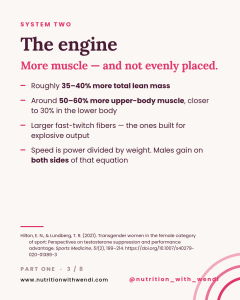
3. The foundation
This is the one almost nobody writes about, and it’s the most important. At puberty, male bone undergoes periosteal expansion — it grows wider from the outside. Female bone adds bone on the inner surface instead. The result is a wider bone with thicker cortical walls and greater mineral content.
Here’s why that matters more than it sounds. Resistance to bending and torsion scales exponentially with bone width, not linearly. A modest difference in width produces a large difference in how much force the structure tolerates before it fails. Larger bone also anchors larger tendon and ligament attachments.
What it produces: a frame built to absorb loads that a differently built frame is not. Hold onto this one it’s the whole safety argument.
4. The fuel system
 4. The fuel system
About 12 percent higher hemoglobin, so more oxygen carried per unit of blood. A larger heart with greater stroke volume, moving more blood per beat. Larger lung volume and greater maximal breathing capacity. Higher VO2 max — substantially higher in absolute terms and still meaningfully higher when scaled to body mass.
What it produces: endurance, repeat-sprint capacity, and recovery between efforts. The gap isn’t just the first sprint. It’s the fourth quarter.
5. The hinge
The female pelvis is wider relative to femur length, which produces a greater Q-angle — the angle between hip and knee. That angle creates more valgus load, meaning the knee tends inward under landing and cutting. Combined with differences in ligament laxity and neuromuscular patterning, female athletes tear the ACL at several times the male rate in the same sports.
What it produces: this one cuts both directions, and I want to say both. It’s part of the performance gap. It’s also a genuine injury-risk difference — which is exactly what makes physical mismatches dangerous rather than merely unfair.
They don’t add up. They multiply.
A longer lever. More muscle on it. Denser, wider bone under it. A bigger engine feeding it. All arriving at once, in the same few years.
That’s why the gap isn’t a single flat number across all sports. It runs about 10 percent in some events and closer to 50 percent in others, depending on how much the event depends on strength, speed and power.
And this isn’t a fringe reading of the literature. In 2023, the American College of Sports Medicine — the largest sports medicine organization in the world — issued a consensus statement on the biological basis of sex differences in athletic performance. Their finding: in events relying on endurance, strength, speed and power, males typically outperform females by 10 to 30 percent depending on the requirements of the event, and those differences emerge with puberty.
That’s not an advocacy group. That’s the professional body that credentials a large share of the people working in this field.
What testosterone suppression does and doesn’t change
 This is a different question from the one above, and I want to keep them separate, because the evidence base is different.
Hilton and Lundberg, in Sports Medicine (2021), reviewed what happens when testosterone is suppressed. Their finding: after twelve months, loss of lean body mass, muscle area and strength amounts to approximately 5 percent. The muscular advantage is only minimally reduced.
Five percent, against a gap that runs 10 to 50 percent.
Roberts, Smalley and Ahrendt, in the British Journal of Sports Medicine (2021), looked at longitudinal fitness records from the US Air Force — 29 transmen and 46 transwomen who began hormones while serving, compared against all Air Force personnel under 30. Before hormones, transwomen ran 1.5 miles 21 percent faster than their female counterparts. After two years, the push-up and sit-up differences had disappeared. They were still 12 percent faster over that mile and a half.
I’ll be honest about the limits, because I’d rather you hear them from me. The Roberts cohort is small, and military fitness tests are pass/fail screens rather than maximal competition. The evidence base here is thinner than anyone would like.
But thin evidence pointing consistently in one direction is an argument for caution, not a reason to dismiss it.
The part few talk about: safety
Everything above is about fairness. I care more about this next part. Force equals mass times acceleration. That isn’t a political statement! It’s the first thing you learn in physics. And the body absorbing that force doesn’t care about anyone’s intentions.
Think about where that shows up. A tackle or a collision in the box. A volleyball spiked from a higher contact point at higher velocity, where the athlete on the other side has a reaction-time threshold below which she physically cannot move out of the way. A lacrosse shot. A pitched ball. And remember the third system. It isn’t only that one athlete generates more force. It’s that his skeleton was built wide, with thick cortical walls, specifically to tolerate that load. Hers was built differently. In a mismatch, the female skeleton is the one receiving force it was never structured to absorb.
We already accept this logic everywhere else in sport. We don’t let heavyweights fight flyweights. Nobody calls that discrimination — we call it the sport having a duty of care. We do the same thing with age brackets, weight classes, concussion protocols and heat policy.
This is a question for coaches, athletic directors and governing bodies. The people who sign off on who takes the field. And World Rugby has already reached this conclusion for contact rugby, restricting eligibility on precisely these grounds after reviewing the evidence.
Now the part coaches need to hear
I’ve spent this whole post describing a gap. Let me tell you what I don’t want you to take from it. Girls are not doomed to plateau.
When girls stall out in speed and power development, it is very often because nobody trained them properly. Sprint mechanics. Progressive strength work. Plyometrics. Force production. These are trainable qualities, and most girls’ programs in this country are not training them.
So the honest version is both things at once. Yes, there is a biological gap that no amount of coaching erases. And yes, the majority of female athletes are being significantly under-trained — and that part is entirely fixable, and it’s on us.
If you’re a parent reading this and you’re angry, put some of that energy here. Ask what strength and speed development actually looks like in your daughter’s program. That’s a fight you can win this season.
Why I keep talking about this
Last year I was traveling in California and a softball mom recognized me from social media. I ended up leading a devotional for her daughter’s team that week — a dugout full of girls who train hard and want to be seen for it.
Those girls are why I write posts like this one. This isn’t about exclusion. It’s about integrity. Women’s sports exist as a category because of biological difference. That’s the whole reason the category was created. Denying the difference doesn’t make sport more inclusive — it dissolves the reason the protected category exists at all.
And this is where I’ll be plain about where I’m coming from. I believe we were made male and female on purpose, by a God who wasn’t confused about it. But notice that not one study I cited above was published by a church. The science stands entirely on its own. My faith explains why I care about these girls. It isn’t the evidence, and I’m not asking you to treat it as evidence.
Silence isn’t neutrality. It’s permission.
If you’re a female athlete, a coach, a parent, or someone who simply cares whether claims are true say something. Ask your athletic director what the policy is. Go to a school board meeting. Read the studies below and make up your own mind.
- References to speed, power and strength in a X Thread HERE.
Let’s protect women’s sports. And let’s do it with the science and scripture on hand. Men can’t be women. Men can’t get pregnant. There are only two genders. Men do not belong in women’s sports.
“So God created man in His own image, in the image of God created He him; male and female created He them.” -Genesis 1:27
The Wendi Irlbeck Show Episode 21: Male and Female He Created Them | Sex Differences in Sport: Full EPISODE Apple, Spotify and on Youtube

References
Coleman, D. L., Shreve, W., & Tucker, R. Comparing athletic performances: The best elite women to boys and men. Duke Law Center for Sports Law and Policy.
Handelsman, D. J. (2017). Sex differences in athletic performance emerge coinciding with the onset of male puberty. Clinical Endocrinology, 87(1), 68–72. https://doi.org/10.1111/cen.13350
Handelsman, D. J., Hirschberg, A. L., & Bermon, S. (2018). Circulating testosterone as the hormonal basis of sex differences in athletic performance. Endocrine Reviews, 39(5), 803–829. https://doi.org/10.1210/er.2018-00020
Hilton, E. N., & Lundberg, T. R. (2021). Transgender women in the female category of sport: Perspectives on testosterone suppression and performance advantage. Sports Medicine, 51(2), 199–214. https://doi.org/10.1007/s40279-020-01389-3
Hunter, S. K., Angadi, S. S., Bhargava, A., Harper, J., Hirschberg, A. L., Levine, B. D., Moreau, K. L., Nokoff, N. J., Stachenfeld, N. S., & Bermon, S. (2023). The biological basis of sex differences in athletic performance: Consensus statement for the American College of Sports Medicine. Medicine & Science in Sports & Exercise, 55(12), 2328–2360. https://doi.org/10.1249/MSS.0000000000003300
Roberts, T. A., Smalley, J., & Ahrendt, D. (2021). Effect of gender affirming hormones on athletic performance in transwomen and transmen: Implications for sporting organisations and legislators. British Journal of Sports Medicine, 55(11), 577–583. https://doi.org/10.1136/bjsports-2020-102329
Tønnessen, E., Svendsen, I. S., Olsen, I. C., Guttormsen, A., & Haugen, T. (2015). Performance development in adolescent track and field athletes according to age, sex and sport discipline. PLOS ONE, 10(6), e0129014. https://doi.org/10.1371/journal.pone.012901


 Under-fueling without realizing it